
Revolutionary times
The entire world order, as we have known it in our lifetime, is rapidly disintegrating.

While the US and Europe are characterized by stagnation, war, and political chaos, the rest of the world is shaking off the yoke of imperialism.
Year-end reviews and summaries characterize the turn of the year. That we are living in “troubled times” has become a phrase that is often used, not least by Norwegian Prime Minister Jonas Gahr Støre. Now, we are told, it is important to ensure “secure governance,” which in practice means pursuing a tight economic policy. Furthermore, it is claimed that our national security depends on NATO membership and that the Norwegian economy is completely at the mercy of the EEA Agreement. Without these pillars, Norway will apparently fare badly.
But this analysis is wrong. We are not living in “troubled times”; it is more accurate to speak of revolutionary times. The tragedy for Norway is that we are on the wrong side of history, with a political leadership—and a parliamentary opposition—that is incapable of understanding the consequences of the radical changes taking place in the world, and which is therefore taking the wrong steps.
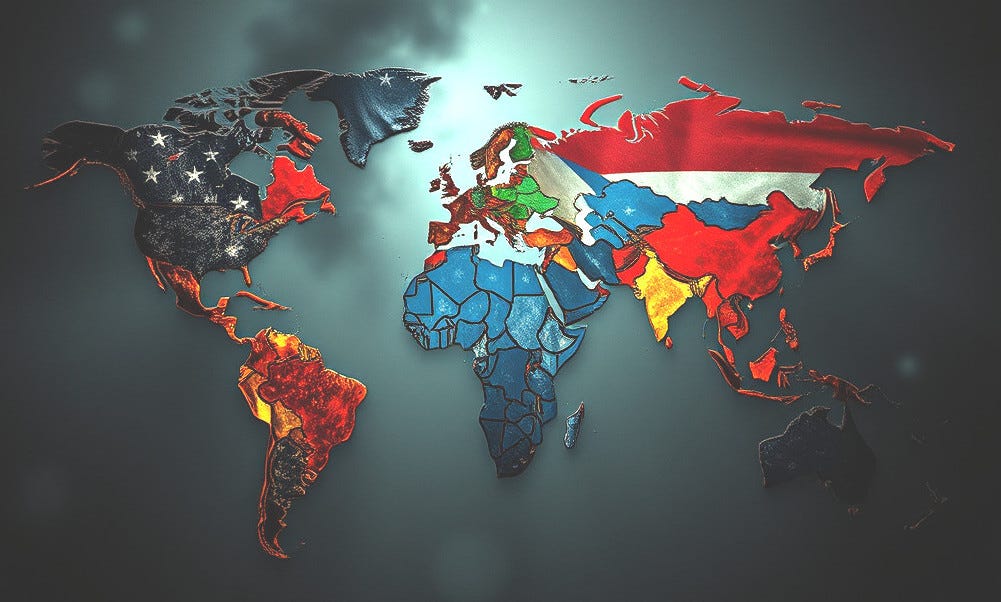
The entire world order, as we have known it in our lifetime, is rapidly disintegrating. From a geopolitical perspective, we are witnessing the end of more than 500 years of Western imperialism, and the political center of gravity is shifting from West to East. At the same time, we will not see a situation like the one we have had since the 1990s, where a sovereign superpower has dominated and terrorized the rest of the world. The transition from a unipolar world, which in practice means the fall of the US as a hegemon, to a multipolar world with several regional power centers, is now happening right before our eyes.
The old center of power is currently undergoing severe convulsions. This is manifested in wars, warmongering, a comprehensive sanctions regime, and economic stagnation. Trump's economic policy is an expression of desperation. Even countries allied with the US are being subjected to high tariffs, a measure intended to shift industrial production to the US. But it will all be in vain; the geopolitical changes cannot be stopped.
The dream of the American imperialists, as formulated by Zbigniew Brzezinski in his book The Grand Chessboard, has been to take control of the entire Eurasian continent, from the Atlantic to the Pacific. This seemed to succeed with the fall of the Soviet Union. Supported by the US, the West, and international financial institutions, Russia underwent a rapid transition to capitalism. The result was disastrous. During the 1990s, Russia's GDP fell by 50%, a historic record for any country in peacetime. The 1990s became the decade of thieves (oligarchs) in Russia, when influential people plundered common assets and became billionaires overnight. Western capital interests followed like vultures. In 1996, Boris Yeltsin was re-elected thanks to election fraud and massive interference from the US.
Vladimir Putin's popularity must be understood against this backdrop. He came in and reversed much of what Yeltsin had destroyed, and took a certain stand against the power of the oligarchs. Putin also refused to be bullied or controlled by the US. American imperialism's dream of controlling the entire Eurasian continent was put on hold.
For strategist Brzezinski, and for influential think tanks in Washington, it was crucial to break Russia. Brzezinski believed that Ukraine's development would determine the security policy development in Europe. This led to NATO's eastward expansion and the US-backed Maidan coup in Ukraine in 2014, which was the prelude to today's tragic war.
Denying Ukraine neutrality meant choosing war with Russia. The US/NATO/EU hoped that such a war would weaken Russia so much that it could be controlled by the West, preferably also divided into smaller states that could be easily controlled. But that has not happened. On the contrary, we see that the US has got cold feet, and that both the EU and NATO are creaking at the seams. It is by no means certain that either the EU or NATO has a future. In order to continue the war, 24 of the EU's 27 member states have decided to give Ukraine a loan of 90 billion euros, money that the EU will raise on the international bond market. The interest will be paid from the EU countries' national budgets, which means severe cuts in Europeans' welfare for the foreseeable future.
While the US and Europe are characterized by stagnation, war, and political chaos, the rest of the world is shaking off the yoke of imperialism. BRICS and the Shanghai Cooperation Organization (SCO) are building a new world order based on mutually beneficial trade and investment.
BRICS was founded in 2009 as BRIC, by Brazil, Russia, India, and China, and was expanded to include South Africa in 2010. Today, BRICS has 11 member countries, and more than 40 countries have expressed their desire to join. The association represents approximately half of the world's population and more than 41% of global GDP. It is an economic superpower, with leading producers of important raw materials. The BRICS countries are challenging the international trade regime that the US established after World War II, a regime that has favored the US and kept large parts of the world in poverty. Of particular importance is that BRICS will transform the international monetary system and challenge the dollar's dominance in world trade.
At the same time, the Shanghai Cooperation Organization (SCO) appears to be a powerful force capable of curbing Western imperialist plans on the Eurasian continent. With China as its driving force, the organization was founded in 2001 as an organization for mutual security and political and economic cooperation. With China, Russia, India, and Iran among its members, the SCO has become a political force that more and more states are seeking to join, dramatically weakening the possibilities for US imperialism.
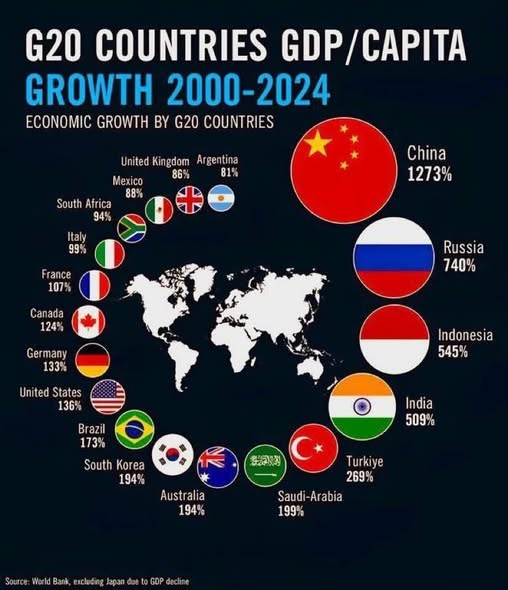
Figures from the World Bank clearly show where the world is heading. While China has seen GDP growth of 1273% since 2000, the US can only boast growth of 136% in comparison, roughly one tenth! Russia has seen GDP growth of 740% since 2000, a figure that demonstrates the wisdom of throwing Western economic advisors out the door.
China is soon to become the world's largest economy and is leading the way in technological development. More and more countries around the world are turning to China for cooperation and inspiration. Communists have reason to feel proud of this. The Chinese Communist Party has ruled the country since 1949. From being one of the world's poorest countries, essentially a backward farming society with massive illiteracy, the party has lifted 800 million people out of extreme poverty and ensured that the entire population shares in the development of prosperity.
If Norwegians want to see with their own eyes what a country on the road to socialism looks like, we can visit China without a visa. Such a visit would be a good antidote to the anti-Chinese propaganda spread by Western media.
Debate on imperialism
Terje Alnes' entire premise in the article 'Revolutionary Times' is wrong. We do not live in revolutionary times, but in deeply reactionary times, in what Lenin called reaction across the board.
It began with the counter-revolution in 1989 and continues to this day.
The prerequisite for revolutionary times is that the working class, in alliance with other progressives, rises up to fight against capitalism. That is what we must work towards. In Lenin's article 'Imperialism and the Split in Socialism' he writes, among other things:
"It is clear why imperialism is dying capitalism, capitalism in transition to socialism: monopoly, which grows out of capitalism, is already dying capitalism, the beginning of its transition to socialism. Imperialism's enormous socialisation of labour (what its defenders - the bourgeois economists - call "intertwining") produces the same result."
That is. that the transition to socialism is a lawful process, but it requires the revolutionary subject to be implemented; communist parties that are not trapped in the swamp of opportunism, but are clarified and capable of uniting across nations.
Debate on the epoch of imperialism!
On January 3, Terje Alnes presented his article 'Revolutionary Times' in the IMM group. In several posts I have tried to have a debate with him, but without success. The only thing he can manage to do is challenge my claim that he is defending Russia in an imperialist war. He claims that he is explaining Russia's position.
His lack of desire to debate the article is due to his inability to use class analysis in relation to the parties in the imperialist war. The crucial question is which class has power?
He completely ignores this in relation to Russia. It is no longer the working class that has power, but the oligarchs who correspond to the monopolies in the Western countries. In reality, we have been knocked back to the time before 1914, when large parts of the labour movement capitulated to imperialism. Nevertheless, it is necessary to use the experiences from 'Imperialism as the Highest Stage of Capitalism' and Lenin's fight against opportunism.